As a veteran in technology, I've spent decades separating genuine opportunities from temporary trends. Today's challenge with AI agents isn't about whether the technology is promising - it's about finding clear paths to real business value.
Drawing from actual implementations, I'll show you exactly where supervised AI agents are delivering value today, with step-by-step workflows you can evaluate against your business needs.
But first, we can avoid the hype if we
a) dispel the mystery around what an AI agent is
b) understand why we won't be replaced with robot overlords any time soon
Grab the cherry on the cake: Flux 1.1Pro
AI Agents: There's No Secret!
AI agents are simply large language models (LLMs) paired with tools and data, working in workflows or teams – just like people do.
Let's step thru an agentic example. Imagine you receive an Instagram comment like this:
"These cupcakes look incredible! 🧁 Would love to get your pricing for an upcoming corporate event, 50 cakes to collect, - reach me at sarah@company.com or 555-0123"
-
ChatGPT processes the social media comment
-
ChatGPT structures a response
-
Convert casual message to your CRM's required quote submission format
-
Enter key details (50 cakes, corporate event, collect) into the format
-
The middle layer, the secret agentic sauce, catches ChatGPT's response and validates it
- eg security concerns, company policies
-
The middle layer submits the quote request to CRM and responds to ChatGPT
The middle layer is the secret behind agents. It orchestrates the workflow, allows us to impose our own logic and policies. We get the best of ChatGPT's fluid responses and the company's approved processes.
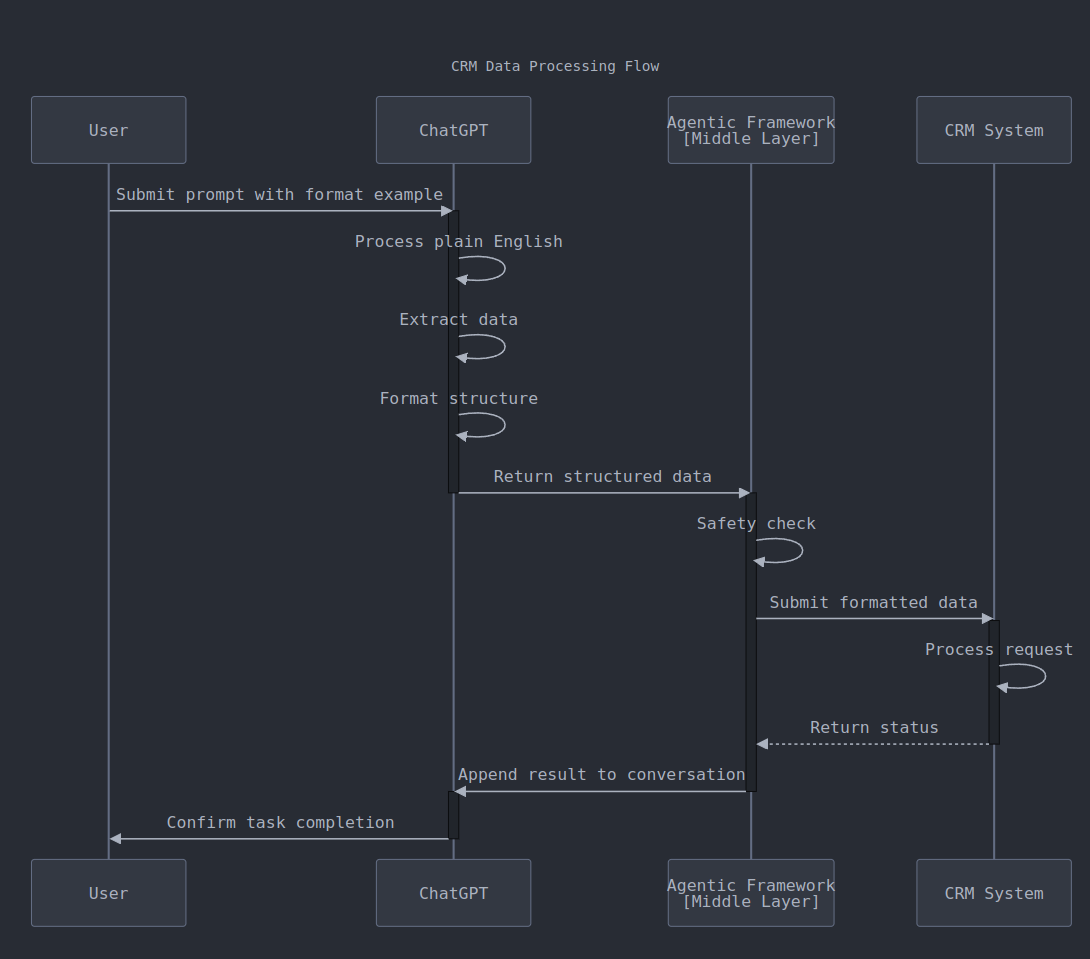
What if this process was not started by a person?
The request for a quote could have come from another company's systems, or their ai agent. The above process could be one step of a long sequence, each step being managed by ai agents. In other words, an 'agentic' workflow.
Whereas chatbots have an element of unpredictability, such workflows can be strictly managed by the 'middle layer', as per our flow chart. This middle layer is just a software tool, such as CrewAI or LangGraph.
Alternatively, the workflow can be executed by a flexible team of co-operating agents, e.g. Microsoft's Autogen. Such teams unleash the intelligence of AI and allow the team to handle unanticipated twists and turns. Especially good in research tasks where the required steps are not known beforehand. But, more liable to go off track, so rarely used in commercial workflows like consumer transactions.
Either way, AI agent's real power is in bridging the gap between our messy world and structured software – automating tasks we thought impossible only 24mths ago.

Think "Digital Interns," Not "Robot Overlords"
Before we proceed, let's allay a common concern. AI agents are interns to assist in your work. As interns they are eager new team members simultaneously full of potential and prone to misunderstanding.
The key is that they don't replace expertise – they amplify it. When an intern drafts a report, the managing user reviews and refines it. When an AI agent processes data, the manager interprets and applies it.
There are two forces in favour of AI proceeding with humans in mind...
-
When a resource become abundant we simply use more of it(Jeavon's Paradox)
-
Energy is the classic example, but intelligence is the same
-
None of the AI tools I build would replace me. They do tasks which would not have been done otherwise
-
AI struggles with easy tasks and excels at hard tasks (Moravec's Paradox)
-
Chess is the classic example, since 1997 computers have beaten grand masters. But computers still cannot manage people to a deadline.
-
This suggests partnership is the most profitable route
Where AI Agents Excel Today: Paths to Value
The business value of AI agents isn't theoretical anymore - over the past year we have built experience in what works. There are your quick wins in automating existing tasks - clear ROI, familiar processes, lower risk. Then there is engaging in new tasks which would not be possible without AI.
Let's look at some examples:
-
Document Processing That Actually Works
Remember when OCR was supposed to solve everything? AI Agents can handle much of missing common sense in those systems, achieving 90% accuracy, humans handle only the exceptions. The workflow is simple:
-
Documents arrive in any format
-
AI agents use existing document tools to
-
Clean data flows to systems
-
Humans handle only the 10% requiring judgement
The key difference? These agents understand context, not just text.
-
AI agents operate an automated lead funnel to sieve the buy signals from thousands of LinkedIn contacts each month.
-
AI Agents conduct targeted searches to gather data on each contact
-
They analyze search results deciding where to focus further searches
-
They rank contacts according to their buy signals they have published in recent weeks
-
Agents compose tailored communications for the top qualified leads
-
The top leads are presented to sales staff, with source links for delving deeper
-
Knowledge Networks That Actually Scale
With AI agents we can greatly alleviate the demands of the RFP process. Typically we have to find a team of experts, find, review and draw together all the relevant documents and previous proposals, then finally structure a response for the client.
But the solution with AI agents is to:
-
Index the text from all past proposals, noting who authored each item
-
Client RFPs are analysed by AI agents for the defining requirements
-
Relevant past solutions and experts are identified
-
Proposal teams are proposed
-
AI agents collate and present initial materials to the bid team, with citations
-
Interview Users At Scale
Questionnaires are useful for marketers but frustrating for customers. Interviews are better but take far too much staff time, so few are conducted. AI agents are the answer:
-
AI agent conducts interviews, filling a formal questionnaire during the conversation
-
Customers give feedback freely without irrelevant questions
-
Customers can revise responses or request clarifications/examples
-
Negative feedback flagged for human follow-up
-
Results sent to a marketing AI, which selects relevant services and case studies
-
All services and case studies are real and unedited by AI, ensuring no misrepresentation
-
Ever watched your top performers spend half their time training juniors? AI Agents can extend expert knowledge without consuming expert time. The workflow works because it captures real expertise in action:
-
AI agents observe experts handling complex cases - decisions, reasoning, exceptions
-
Agents create practice scenarios from real cases, maintaining critical details
-
Junior staff work with AI coach, getting real-time guidance
-
Experts only review edge cases and update decision rules
-
Knowledge base grows automatically as new cases are handled
The Key Pattern: Start Simple, Think Big
The pattern is clear:
1. Build confidence with automation workflows for quick wins
-
Document processing
-
Communication management
-
Data entry & validation
-
Multi-system integration
-
Quality control
2. Build toward new capabilities that transform your business
-
Predictive operations that prevent problems
-
Knowledge networks that scale expertise
-
Adaptive systems that evolve with use
-
Operations at previously impossible scales
The most successful organisations don't stop at automation - they use it as a stepping stone to enabling entirely new capabilities.

Implementation: Start Smart, Scale Fast
Begin With Clear Metrics
Choose workflows where success is easily measured:
Focus on Human Enhancement
-
The most successful implementations share a pattern:
-
AI handles volume and routine
-
Humans focus on judgement and exceptions
-
The system learns from human decisions
-
Capacity grows without quality loss
Next Steps: Your Action Plan
1. Allow AI enthused staff to explore your current processes for:
2. Start small:
-
Pick one workflow
-
Define clear metrics
-
Run a controlled pilot
-
Learn and adjust
3. Scale what works:
Remember: Most AI Agent workflows need some form of human oversight. So, the goal isn't to replace humans but to enhance their capabilities.
Ready to start? The future of AI agents isn't in revolution – it's steady, measurable improvement that creates real business value.
| |
| --- |
| Agentico is among the first Agentic AI advisors in the UK, supported by 10 yrs in Machine Learning and 20yrs in analytics.Make sense of, and leverage, the seismic changes that AI agents are bringing to marketing or your industry. We're happy to talk more about the opportunities of Agentic AI and ML at your organization or event. Get in Touch
Agentico.ai: AI with humans in mind |


