MIT + Harvard Economists on Agentic AI and Strategic Disruption
MIT and Harvard economists have just published a major report on AI agents and market disruption — and it’s a fascinating glimpse of what’s next.
Their core message? The transformation is not about automating old processes. It’s about reinventing markets and organizations around what agents can uniquely do.
Reinventing Markets
“Perhaps the most consequential and transformative change AI agents enable is the practical deployment of theoretically superior market designs that have long remained underutilized...” (p.18)
Most matching platforms today — think Upwork or Tinder — rely on simple recommendation systems that show everyone the same “best” options, leaving many people unmatched. The report argues that agents could make far more sophisticated market designs practical at scale, leading to fairer and more efficient matches.
One of the designs they mention is Gale-Shapley matching, which underpins new agentic AI platforms like JackAndJill.ai in recruitment.
Reinventing Companies
"Coase’s insight from 1937 that transaction costs play a central role in shaping organizations is particularly useful..."
Coase’s classic idea is that companies exist because markets are costly — finding suppliers, negotiating, writing contracts, and managing relationships all take time and money.
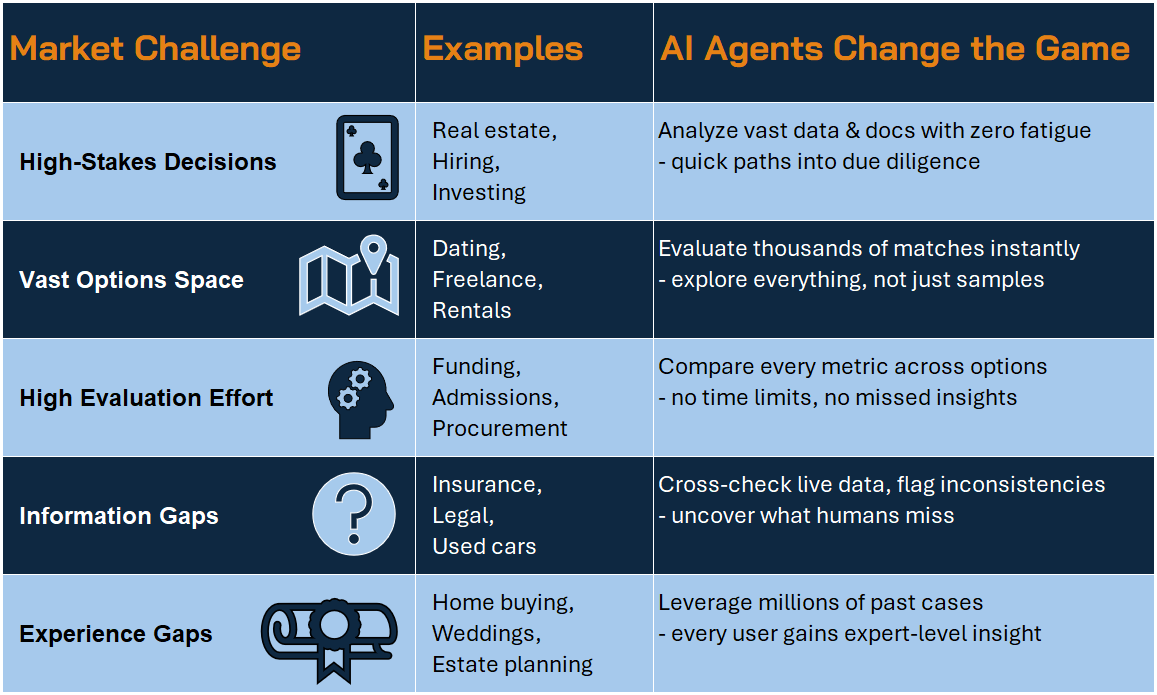
The report suggests that these are exactly the kinds of activities AI agents can perform at very low marginal cost. Once agents can handle these functions effectively and cheaply, we’ll see major shifts in the boundaries between firms and markets.
They also note that agents will enable undertakings that previously weren’t worth attempting . By lowering the cost of exploration and execution, agents expand what’s possible — from diagnosing a home repair to sourcing parts and scheduling service.
New Frictions
Of course, every new technology introduces new frictions — and therefore new opportunities to resolve them. The report highlights a few:
-
Firms may adopt more price obfuscation to confuse agents.
-
Personalized pricing could both benefit and disadvantage consumers.
-
Consumers’ agents might withhold information to gain better deals.
-
AI tools that make job applications effortless could flood employers, creating new hiring challenges.
These frictions aren’t just problems — they’re the next generation of opportunities for agentic innovation. JackAndJill.ai, for instance, is already working to relieve this application overload.
Next Time: Templates for Reinvention
Next time, we’ll look at practical templates for reinvention with agents — concrete patterns showing how new agentic business models are already taking shape: how new participants change marketplaces, and how those new markets reshape payments and pricing.
Report Source:
"The Coasean Singularity? Demand, Supply, and Market Design with AI Agents"
National Bureau of Economic Research. September 2025.
https://www.nber.org/system/files/chapters/c15309/c15309.pdf
10 Paths to Win in Agentic Commerce


