The Lesson Learnt
On 12 June 2026, Anthropic's most capable model, Fable 5, was barred for access by any non-US national, anywhere, and because no one can verify nationality on every API call, Anthropic switched it off for everyone.
Anthropic are an international team, so owning a proprietary model didn't save their own staff's access. And the world's best alternatives, open weight models, are Chinese, which simply introduces new concerns for many enterprises.
The immediate lesson is the model is the one part of your AI stack you should be prepared to lose overnight. But the stack offers surprising opportunities to keep ownership of intelligence and make models replaceable.
Corporate Sovereignty in the Age of AI
Sovereignty is a hot topic. IBM calls AI sovereignty control over your whole stack; data, models, operations. Stanford's HAI says the enterprise version is operational control: on-prem, no vendor dependency, your data and models in your hands. Practitioners say: "own what matters, rent what doesn't"; every prompt feeds your vendor's moat, not yours; architect for "escape velocity."
All fair and to some extent open weight models can be an answer. Work can be tiered: run the volume on cheaper open weights no one can deny you. But my experience is that frontier models from the US labs are much better at many use cases. Avoiding them means cutting quality substantially.
Yet, new insights show how we can save expertise outside the model, so we can more easily replace any given model.
3 Rules to Own Your Expertise
-
Your knowledge is your context. Every correction your people make is institutional knowledge, keep it in a wiki you own. Google's new Open Knowledge Format (launched June 12th) makes that a plain-markdown standard and it transfers to the next model without fuss.
-
Your expertise is the path taken thru that context; Your edge is not the model's intelligence and the knowledge (rule 1 above) is just the enabler. Expertise is the route your business takes through that knowledge, the 'chain of thought' given the constraints. You can own a record of that decision path if your knowledge is recorded in OKF, which is basically an enriched graph. See "Graph-Constrained Reasoning (Luo et al., ICML 2025)" for a formal understanding of how the path is the expertise.
-
Own the workflow, or the workflow owns you. Today the orchestration of AI agents is business process management. Such orchestration keys deeply into your business and is therefore the most expensive thing to rebuild. Thankfully, most orchestration frameworks remain open source. To make them even more interchangeable and governable, Databricks recently abstracted these frameworks into a single open-source Omnigent (also June 12th). This allows you to swap not just the model, but also its framework (think claude code vs codex) with a one-line change; Anthropic's Model Context Protocol does the same for tool and data connections.
The kill switch as a duty
Some regulated buyers already refuse Chinese-origin models outright. Fable 5 is the mirror image: a US-origin model, switched off by Washington, for everyone outside the US. A company that runs on one model, from one provider, in one jurisdiction has handed a foreign politician a kill switch over its operations. After 12 June, that is hard to defend in a board proposal.
Decision Power: The Coming Sovereignty Frontier
Currently AI is asked to deliver on tasks and then humans overseeing the output apply their judgment, deciding what must be done next. Whereas with Fable 5 we had a glimpse into a world where we began to trust the model's judgment for what task comes next, what is 'good enough', what is the best option of the many choices to pursue next.
And this makes us fast, it appears to step us towards the billion dollar company with one employee. But it highlights the next sovereignty question, even if we are far from one person per billion dollars of revenue.
We already understand that a company which hires all its meaningful intelligence from an AI vendor is a franchise of that vendor. Spread the contracts across several vendors and we still don't escape the problem: a foreign politician's signature is a single point of failure. But even if that was overcome with on-prem open weights models, we have still yielded sovereignty.
No human can review a thousand agents' decisions; there are too many an hour. So the AI can't merely be intelligent, it has to be self-directing: setting priorities, resolving conflicts, choosing without asking. But to direct yourself for hours or even days is to have intent. And a system that skilfully exercises intent necessarily has intentions of its own.
That requires trust and in business true trust runs on shared downside. We trust those who have skin in the game, but a self-directing machine loses nothing. A human employee is the opposite: a reputation that follows them and a mortgage to pay.
So the one thing we cannot rent is the intent that underlies meaningful decisions. People with judgment and loyalty, who have skin in the game, aiming the machines at our common purpose.
In a world of cheap rented intelligence, expect employees to be a source of sovereignty.
Own the Stack, Rent the Model
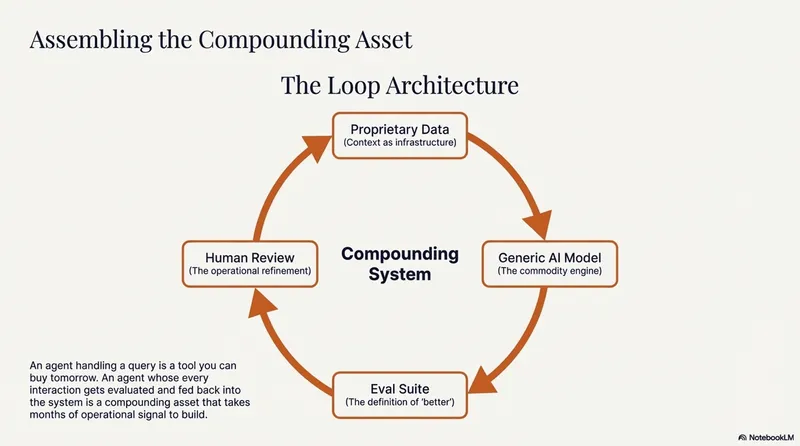
Back to today. Rent the best model but it should be replaceable by design. Collect and own the rest of the stack: the data, the paths your business reasons along, the workflow that runs it, and the people pointing the whole thing at your purpose.
Lose the model on a Friday and the business should be trading on Monday; but lose the people and the company is lost. The model was never the asset. It was a contractor, working on everything we own.