Corporate Sovereignty in the Age of AI
Washington demanded Anthropic switch off its best model for non-US users. But the AI stack offers surprising ways to maintain sovereignty away from AI models
Written on
METR's data shows the length of tasks AI completes reliably doubling every seven months; humans hold focus for twenty minutes. Attention, scarce for fifty years, is becoming abundant. If attention is no longer the constraint, what is, and where should you deploy agents?
The attention economy has been pre-eminent for years. But a phase change happened in early 2026 that most haven't fully absorbed yet.
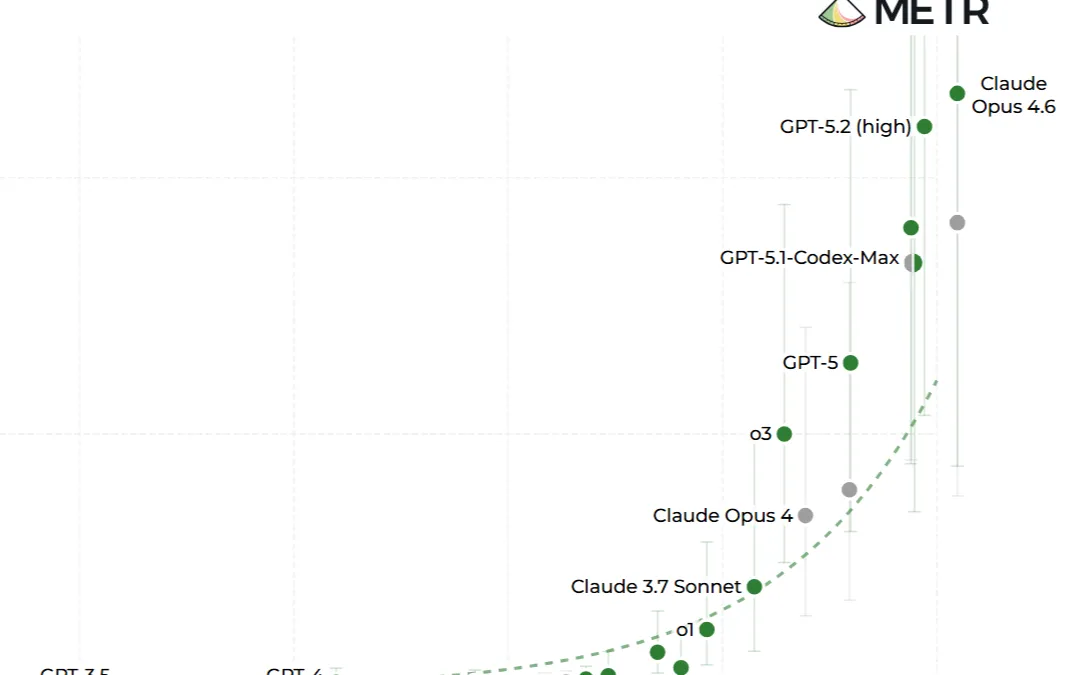
The length of tasks AI agents complete with reliability has been doubling every seven months for six years [ METR]. In March 2026 METR estimate AI can complete about 25mins of human equivalent work at 95% reliability (or 1hr at 80%). The past 12months has seen incredible growth. By comparison humans can give high vigilance attention for about 20 minutes, [ Zhou et al, 2025]. The past 12months has seen incredible growth.
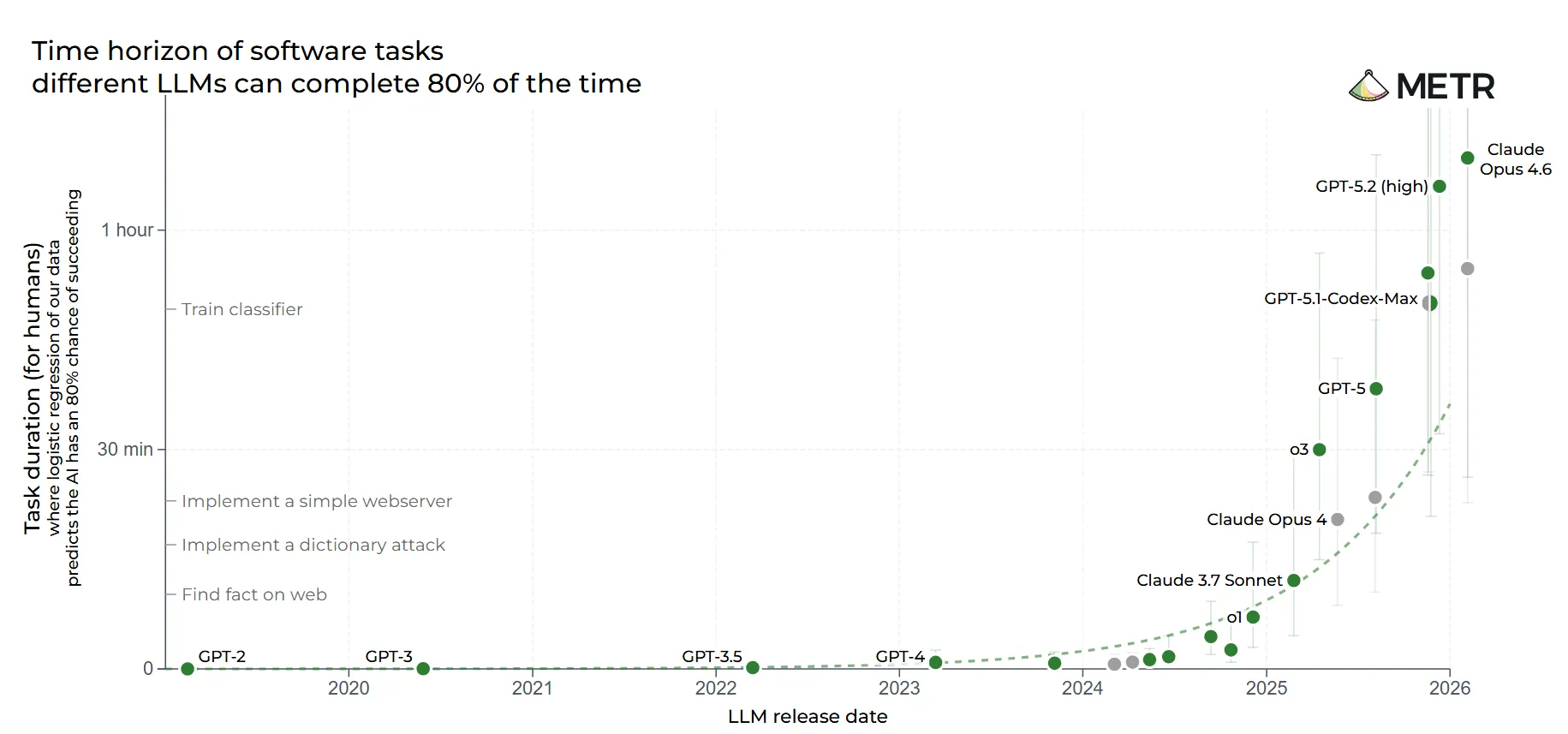
From now on AI will explore focus durations that most of us will rarely achieve, and do so 'on tap', undistracted by messaging and Instagram itch. Attention was once a scarce traded resource, now it is abundant. That's the phase change.
But it is not just the duration of AI focus, but also the quality that has leapt ahead recently.
ARC-AGI is an IQ test for AI, commonly referred to as the gold standard for genuine novel reasoning. This year ARC-AGI v1 has become saturated, models routinely achieve >95%, same as humans. On ARC-AGI v2 Google's Gemini 3.1 scores 77.1%, GPT-5.4 hits 74%, Claude Opus 4.6 reaches 69%. An individual human may expect 80%. Six months earlier, GPT-5 scored just 10%, a phase change in quality has occurred.
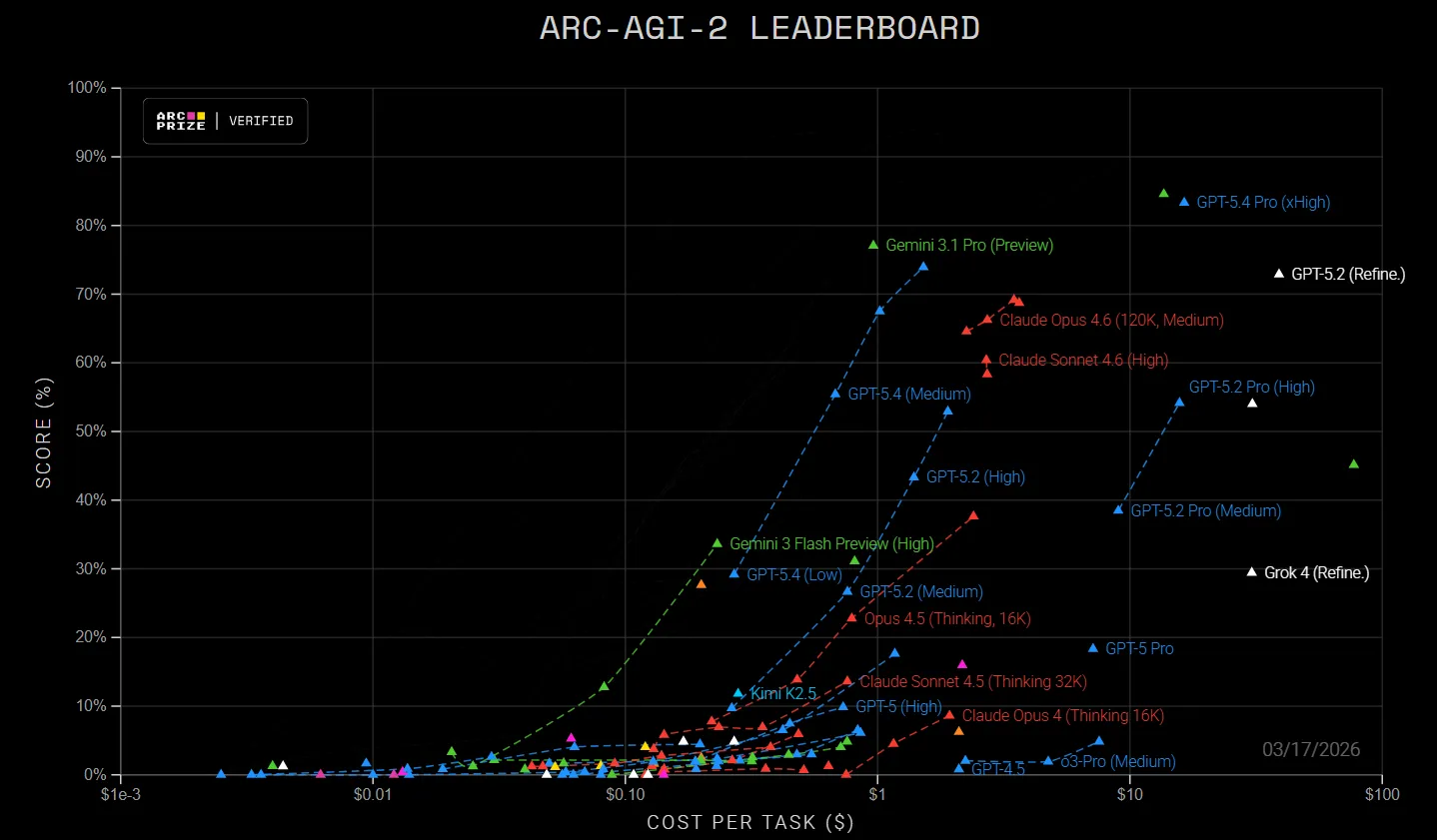
Later this month ARC AGI v3 is launched, its based on games and designed for people too. If frontier models saturate it quickly then we may genuinely need AI to mark AI's exams, since no human could provide a reliable equivalent performance.
If looking for refuge for human superiority then you can still find some in this report from UK AI Security Institute
Physicists at the Institute of Advanced Study (where Einstein worked in his later years) are already getting a taste of their role changing. Dr David Kipping, Columbia University compares it to Adam and Eve picking the forbidden fruit, suggesting that once the productivity boost is tasted, there is no going back. But as experts oversee the AI, Kipping says "it's a very different kind of intellectual activity. It's more like the exclusive role of just being a mentor or an adviser or a manager really in that sense rather than necessarily working through the problem yourself".
This matters for planning because organisational transformation takes time. It takes at least a year from "go" to getting the agentic company moving in the right direction. Two years from first pilot to operational maturity is optimistic.
To understand why this moment is different, it helps to think about what has actually been scarce in the knowledge economy. Herbert Simon articulated it way back in 1971: a wealth of information creates a poverty of attention.
For fifty years, that was the defining constraint. The engagement economy was engineered to fracture human focus and monetise the fragments, what Bruineberg characterises not as information overload but as the continuous availability of effortless action.
It is not the volume that overwhelms us; it is that scrolling is frictionless while thinking is expensive. The paper " From Attention Economy to Cognitive Lock-ins" extends concerns to AI.
Social media trained a generation and a workforce to skim rather than read. A 2025 NTU study confirmed that social media is measurably weakening sustained attention in young adults, training the brain to seek constant novelty through dopamine-driven feedback loops.
But as agents grow more capable, as they cross the thirty-minute threshold, then the hour, then the day, the scarce resource shifts. Intelligent attention becomes abundant and will be delegated to AI.
What cannot be delegated is the judgment to decide which questions are worth asking, which explorations are dead ends, and which results to trust. There will still be one neck to wring should there be an error.
We are entering what I call the judgment economy. And it demands a different kind of leadership.
In February the UK government's AI Safety Institute published a study measuring improvements when workers use AI across different task types.
On structured, analytical tasks, AI delivered clear gains. Monitoring processes, materials, and surroundings saw a 22% quality improvement.
Drafting and specifying technical components saw a 23% quality improvement.
Interpreting information for others showed no quality gain but a dramatic 42% reduction in time and a 102% improvement in points per minute.
These are attention tasks, working through information systematically, and AI excels at them.
But on the task that required judgment, organising, planning, and prioritising work, where the output was a subjective, open-ended, forward-looking strategic proposal, there was no statistically significant uplift on any metric. Not quality, not speed, not efficiency.
AI amplifies attention. It does not replace judgment, yet. This has direct implications for where you deploy agents and where you do not.
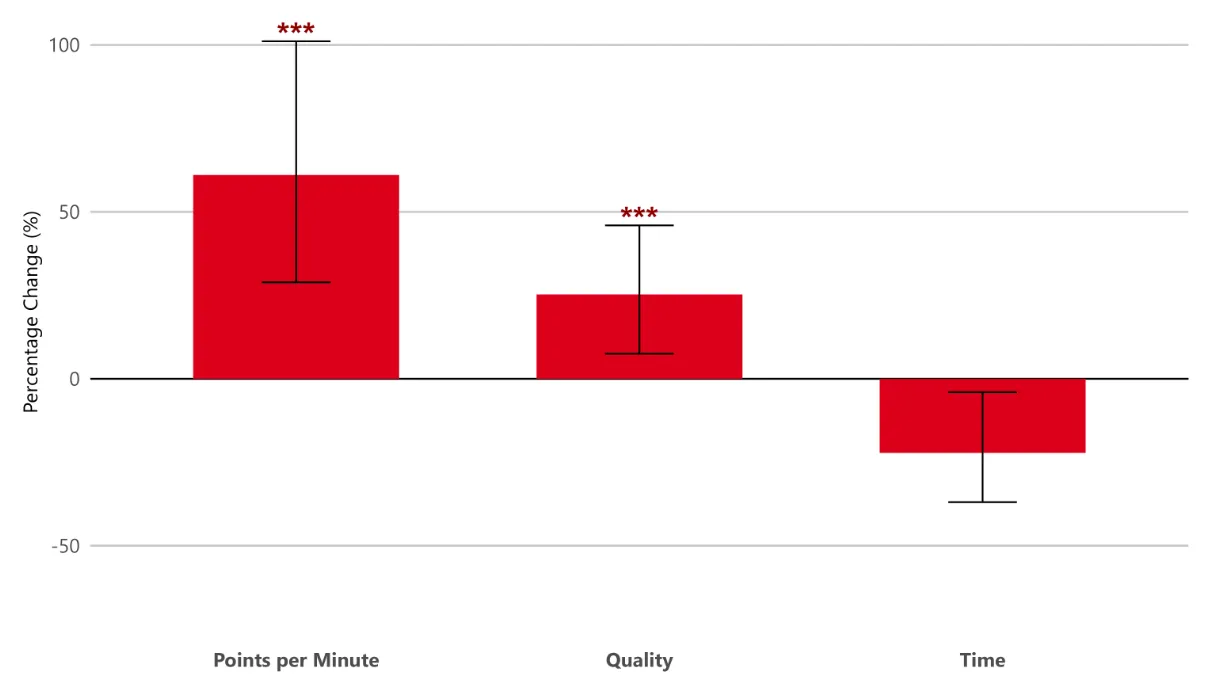
UK AISI: Average impact of use of AI on four tasks vs a control group (Feb 2026)
Consider the extreme case: Sam Altman and Dario Amodei have both the first one-person billion-dollar company, powered by AI agents, within the next two years. Set aside whether you believe the timeline. The thought experiment is instructive.
That human CEO cannot hope to know everything happening in their business. Their agents' collective attention far exceeds the CEO's, across more data, more channels, more operations than any human could monitor.
The constraint isn't whether the AI can do the work. The constraint is whether the CEO can judge the work and trust her AI colleagues. As researcher Andrej Karpathy noted about automation in software development, the basic unit of work is now an agent, not a file.
So the agentic company needs a new management discipline. Not just what tasks to automate, but how to evaluate AI judgment. Not just how to deploy agents, but how to build the governance structures that let you trust them, or catch them when they drift.
The AISI report uses a helpful concept here: the "adaptation buffer" — the gap between when a capability is known and when it becomes practically exploitable. Strong governance during this buffer period lets you deploy the benefits while the risks mature.
The companies that will thrive in the judgment economy are the ones building three capabilities now.
The technical infrastructure for agent deployment
The governance frameworks for agent oversight
The organisational culture that treats AI judgment as something to be earned, tested, and verified, not assumed. The judgment economy demands that we learn to evaluate AI character(sycophancy, scheming, etc)as rigorously as we evaluate AI capability. Just as we do for people.
It takes a year to build these foundations. The clock started in early 2026.
---
Oliver Morris is the founder of Agentico helping enterprises build the agentic company. This is Part 1 of a two-part series. Part 2 explores what it's actually like to work alongside AI agents today, the discoveries, the dead ends, and the new discipline of managing a herd of artificial minds.*
---
Reports and Benchmarks
- UK AI Security Institute, [Frontier AI Trends Report](https://www.gov.uk/government/publications/ai-security-institute-frontier-ai-trends-report), December 2025 — Figures 1.2, 1.3, 2, 3, 5, 7, 15, 16
- UK AI Security Institute, ["AI and the Future of Work: Measuring AI-Driven Productivity Gains"](https://www.aisi.gov.uk/blog/ai-and-the-future-of-work-measuring-ai-driven-productivity-gains-for-workplace-tasks) — Human uplift study across four task types
- METR, ["Measuring AI Ability to Complete Long Tasks"](https://arxiv.org/abs/2503.14499), arXiv:2503.14499, March 2025
- ARC Prize Foundation, [ARC-AGI-2 Leaderboard](https://arcprize.org/leaderboard) and [ARC-AGI-3 Announcement](https://arcprize.org/arc-agi/3/), March 2026
Attention Economy and Cognition
- Simon, H. (1971), "Designing Organizations for an Information-Rich World" in Greenberger (ed.), *Computers, Communications, and the Public Interest*
- Bruineberg, J. (2025), ["Rethinking the Cognitive Foundations of the Attention Economy"](https://www.tandfonline.com/doi/full/10.1080/09515089.2025.2502428), *Philosophical Psychology*
- Hansen (2024), ["From Attention Economy to Cognitive Lock-ins"](https://journals.sagepub.com/doi/10.1177/20539517241275878), *Big Data & Society*
- Wolf, M. (2018), *Reader, Come Home: The Reading Brain in a Digital World*
- NTU Singapore (2025), [Impact of Social Media on Young People](https://phys.org/news/2025-07-international-impact-social-media-young.html)
- Short-form Video and Sustained Attention, [Narrative Review 2019-2025](https://www.researchgate.net/publication/397712802)
Agent Capabilities and Risks
- Goal Drift evaluation, [arXiv:2505.02709](https://arxiv.org/abs/2505.02709), May 2025
- AI Agents vs. Agentic AI taxonomy, [arXiv:2505.10468](https://arxiv.org/html/2505.10468v1), May 2025
- 2025 AI Agent Index, [arXiv:2602.17753](https://arxiv.org/abs/2602.17753)
- Principal-Agent framing for multi-agent systems, [arXiv:2601.23211](https://arxiv.org/pdf/2601.23211), January 2026
- Alignment faking in LLMs, [arXiv:2412.14093](https://arxiv.org/html/2412.14093v2), Anthropic, December 2024
- LLM overconfidence, [arXiv:2509.25498](https://arxiv.org/abs/2509.25498), September 2025
- Sycophancy evaluation, [arXiv:2502.08177](https://arxiv.org/abs/2502.08177), February 2025
Washington demanded Anthropic switch off its best model for non-US users. But the AI stack offers surprising ways to maintain sovereignty away from AI models
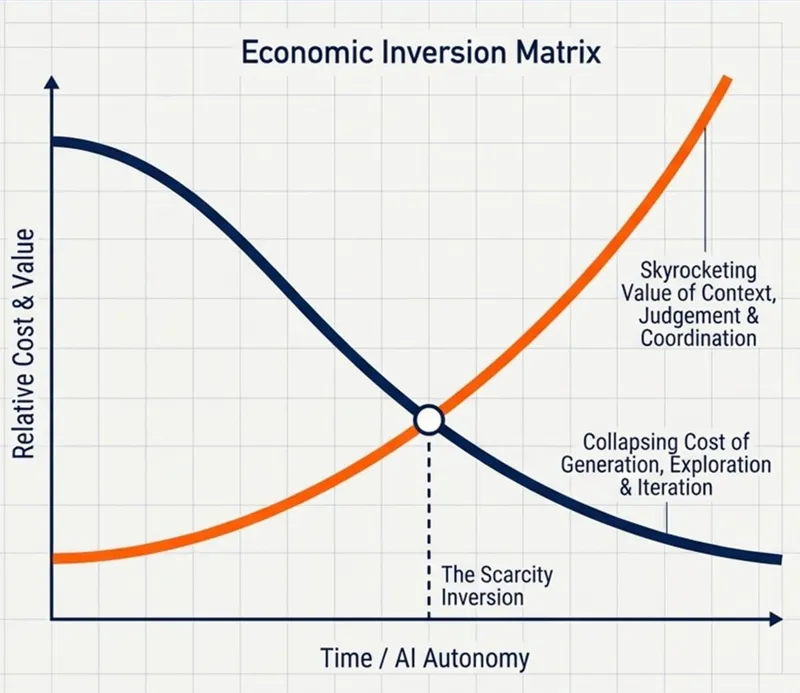
When cognitive labour was scarce, firms built processes to protect it. Now agents generate drafts and fixes faster than humans can inspect, and review becomes the bottleneck. If intelligence is suddenly cheap, what becomes scarce inside the firm, and what must leaders redesign?

A new MIT and Harvard report reaches back to Coase's 1937 theory of the firm and Gale-Shapley matching to argue the real prize isn't automating old processes. The boundaries between firms and markets start to move. So where does that leave your competitive advantage?